By: Sophia Schack
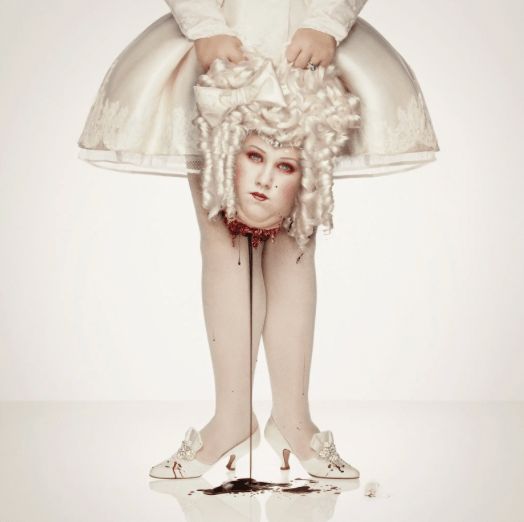
What is the obsession with extravagance? There is something that keeps drawing people into the opulence of eighteenth-century France, at the dusk of an absolutist monarchy. The masquerade of careful appearance curated within ornate golden walls and hallways of mirrors, where one was constantly accosted by their own apparent perfection, has been ceaselessly revisited in pop culture, novels, movies, and couture. Through modern media, we act as voyeurs, or maybe actors, taking pleasure in playing make-believe that we are the ones gliding through the halls of Versailles.
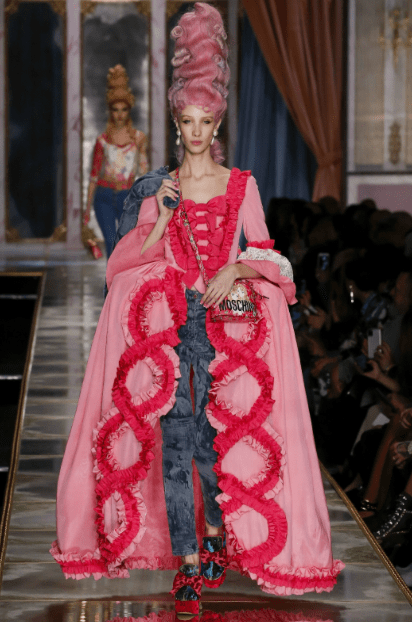
The World of Appearances, which absolutist France propagated, continuously grasps fashion by the neck, breathing life into the opulent daydream that royalty personified. No character more clearly embodies this ideal than the Queen of Fashion herself, Marie Antionette, who is more readily recognized for her lavish lifestyle and overconsumption than her political role as a child bride and a spoke in a wheel of monarchy and destitution. Either loved or hated, there is no doubt that Marie Antoinette’s character expanded larger than her person, creating a carefully curated image of herself based on her clothing. With the little tools that she had access to, in a time where a woman was more a symbolic figurehead than flesh and blood, Marie Antoinette used fashion as a mode of expression and armor, dressing herself to enhance her symbolic power as well as state her clear defiance of traditional gender norms and social class.
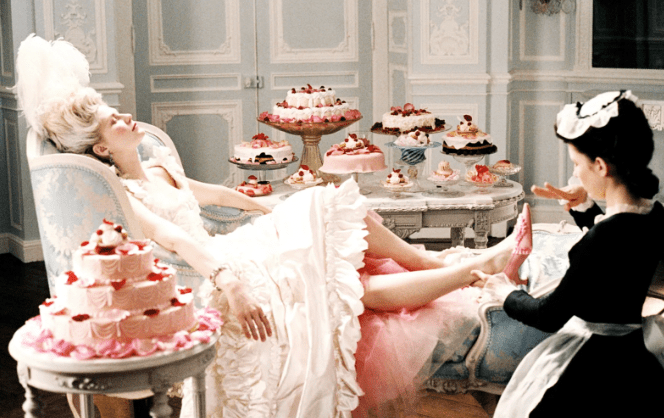
A woman that had been reviled as the downfall of the French monarchy is now seen as a chick icon of women’s fashion, an It Girl of her time and a peak of luxury. The popularity of Sofia Coppola’s film, Marie Antoinette (2006), greatly contributed to a sympathetic image of a young girl thrust into a space where visual culture was prominent. Her role as queen was a performance, and her wardrobe was used as a prop on the stage which she was performing on. Yet, her attempt at control over her appearance and teenage rebellion of court norms backfired in the opinions of the commoners and aristocrats.
As a major influencer of style, many saw Marie Antoinette’s excessive tastes in clothing, hair, and jewelry as a deterioration of morality, and “as women powdered their poufs, the people starved”1. Today, she is viewed as a symbol of the vilification of women involved in politics, a girl with no real power scapegoated for the overspending of state officials. Coppola’s fun and fresh portrayal of Antoinette appeals to a female audience, relating to common themes of “independence, sexual initiation, marriage, and motherhood.”2 Through pink frills, large skirts, three-foot tall hair, and endless jewels, Coppola created a historically inaccurate caricature of a tragic figure in a period of political and social revolution. However, this image has burnt its way so far into pop culture and the image of the French Queen, that Marie Antoinette becomes an endearing and playful girl, celebrating an abundance that was offered to her, but not demanded by her, contrasting her contemporary critics.
While there is still much discussion over the content of Marie Antoinette’s true character, the image that has survived over two hundred years is one defined by her fashion. To carry on her legacy, Manolo Blahnik’s September 2025 capsule collection is a celebration of Marie Antoinette’s style through her shoes, mirroring historically accurate designs while also taking inspiration from Sofia Coppola’s Marie Antoinette, in color and silhouette. The legacy of elitist fashion continues through the Manolo collection, and at only $1,625, a pair of Vasoilette heels which are “reminiscent of the former Queen’s iconic and elaborate style,” can be anyone’s gateway to imitating the teen queen.3 Yet, the designs veer closer to the girlish and whimsical image of Marie Antoinette suggested by Coppola, furthering the notion that this modernized and palatable version of the queen is, in fact, real.
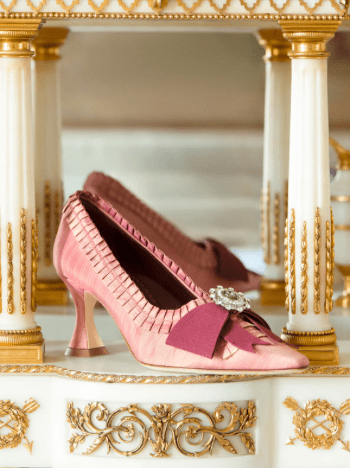
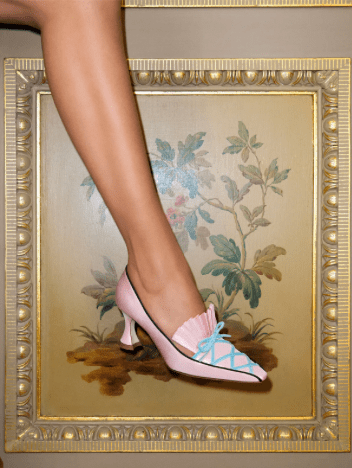
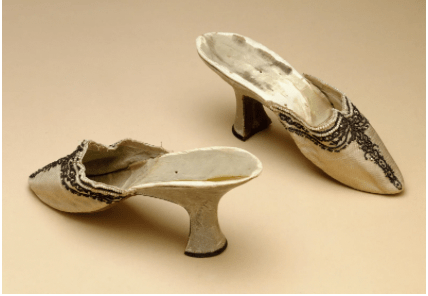
Manolo Blahnik, Beaded slippers belonging to Marie Antoinette.
In partnership with the Victoria and Albert Museum, the collection and museum exhibit showcases the exotification and romanticization of Marie Antoinette, as well as the revilement her person had to suffer through in her life and for the duration of the French Revolution. There are samples of her perfume, a lock of her wheat-colored hair, and the supposed guillotine blade which took off her head. The entire concept is both fascinating and grotesque, emerging one’s senses to fully embody the life of Marie Antoinette. The exhibition celebrates the fashion which she had inspired, including but not limited to Dior, Moshino, and Alexander McQueen, all having pieces that celebrate the Style Queen’s recognizable silhouettes and adornments. The curation of “Marie Antoinette Style” at Victoria and Albert skillfully exhibits the weapons which Marie Antoinette was allowed to bear against her enemies and the blood she had spilt despite her efforts.4
Is this an ideal we should be emulating? Despite claims of the morality of Marie Antoinette, her actions remain true: her frivolous spending in a time of economic ruin, her love of material goods, and obsession with appearance. While it could be argued that these aspects of her character might be over exaggerated or roles that she, as a figurehead of a monarchy was pushed into, does it bode well that we admire her? The phenomenon of her popularity is a testament to consumer culture, in which new marketing tactics repackage the same dream that anyone can fill the shoes of Marie Antoinette for a time, living in the fantasy of what endless wealth, gambling, dresses, and partying would be like.
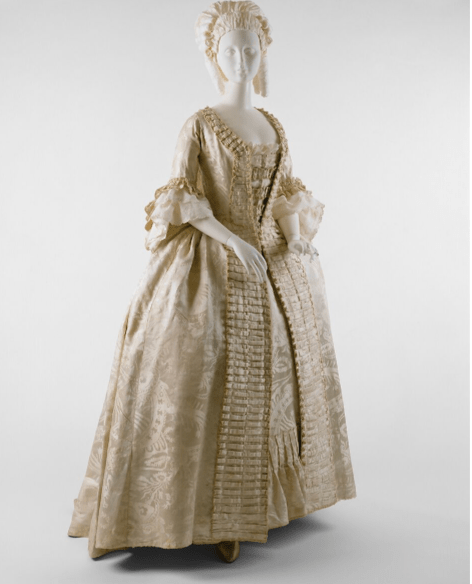
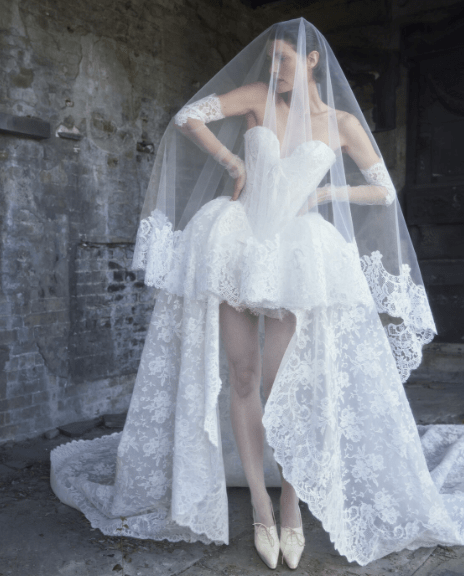
Vivienne Westwood, Marie-Antoinette
In the 2025 Vivienne Westwood couture bridal collection, a dress is outright named for Marie Antoinette, featuring some of the most recognizable features of the robe à la française, the “quintessential dress of the eighteenth century,” with a low neckline, fitted bodice, a sack back, and a full skirt supported by panniers.5 Dressing in the image of a queen who had an arranged marriage at fourteen years old after leaving her home, left unconsummated and under pressure for a male heir for ten years, at one’s wedding, exemplifies the deliberate rose-colored glasses Marie Antoinette’s legacy is viewed through.
The addition of panniers to a dress has become a marker for historical inspiration. The runway has successfully taken a style of dress that had been a sign of oppression and monarchy, and made it avant garde and chic. John Galliano’s collections for Dior had always been famously inventive, outrageous, and pushing conventional boundaries. His Fall 2000 couture show morphed from a wedding to a peculiar show of costume, exploring ideas of sex and fetishism through this play of high fashion dress-up.6 Galliano’s impression of Marie Antoinette defines her as a creature of desire, with a corseted dress that shows her legs and ankles, while still transforming into a type of over-exaggerated performer, with a powdered face and a tall, feathered wig. The fake blood dripping down her neck only contributes to the fixation of Marie Antoinette’s lavish life and violent death, nevermind the irony of the couture show opening with a wedding, her own political marriage being her death certificate.
The sexualization of the corset and eighteenth century silhouette continues in more modernized interpretations of the queen. Photographed for Vogue World 2025, a Louis Vuitton dress meant to imitate the form of a corseted dress while removing important aspects of the dress itself, pursues the duality of Marie Antoinette’s legacy as a fashion and sex icon. While still sporting the core aspects of a corset with panniers, the top half of the dress is a nude-colored modernized corset. This version of Marie Antoinette is both covered and exposed, fashionable and sexualized. She is not given the privilege of hiding beneath the layers of her dress meant as her armour, stripped bare under a modern lens and reduced to the stereotypes of her character.
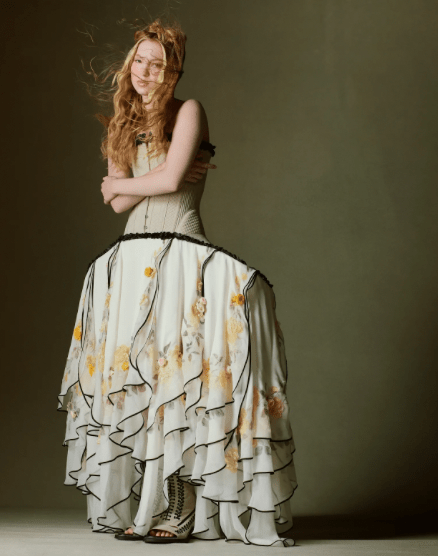
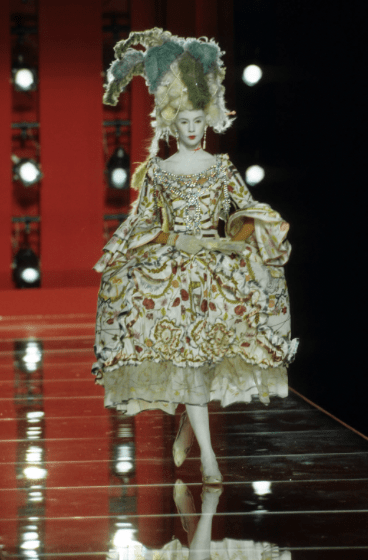
A nude queen, a ruler hated by the aristocracy for her alleged affairs, and hated by commoner women for her supposed freedom from the chains of womanhood. A child bride whose head was chopped off for her marriage. She was reviled for playing a political game as a woman, and equally despised for not doing enough for her people. There are endless contradictions to the truth and legacy of Marie Antoinette’s character that exhibits the idolization of a tragic woman, and the hope of modern-day girls to fulfill this fantasy without the social and political ramifications the queen faced. There is no doubt that the dresses in her image are beautiful and artfully done, with a fresh take on a traditional silhouette emulating a royal fantasy. Truly, we all hope to some day be Marie Antoinette, and we have already become a society full of them.
 cufashionsociety.com
Leave a comment