By: Riley Taylor
The name ‘Hermès’ carries the weight of centuries dedicated to inspiration and heritage, cementing the French fashion house as the pinnacle of luxury quality and the ultimate status symbol. In comparison, other major houses, such as Chanel and Dior, appear to be making a mockery of the prestige that the label ‘Made In France’ once carried, with mass production and alarming human rights violations becoming the most recognizable component of their brand identity. Today, Hermès is one of the last remaining bulwarks protecting craftsmanship and legacy that classifies ‘luxury’ from more cost-effective items.
Founded in 1837 and originally specializing in equestrian equipment, Hermès is most widely recognized for its expertise in textile manipulation. The house has produced numerous iconic bag styles and garments that take over 20 hours to craft by artisans who must have completed at least 5 years of speciality training before being able to work independently. What sets Hermès apart from other French fashion houses is its unwavering dedication to upholding its legacy. Hermès’ commitment to heritage begins with its leadership, as continually shifting direction can lead to an unnatural and fast-paced evolution of a brand, rather than a steady and natural progression. The current Artistic Director, Pierre-Alexis Dumas, has been with the brand since 1992, assuming the role of Artistic Director in 2005, indicating how Hermès values its leaders having a deep understanding of its operations, rather than simply being proficient in their roles.
The fashion house has split its various consumer offerings into 16 different ‘métiers’ – French for ‘trades’ – each having a specific creative director, with Dumas overseeing all of them. The different métiers are split by garment, including women’s silk, men’s silk, belts, hats, and gloves, and belts, indicating Hermès’ diligent and intentional development in all of their offerings – even those with lesser revenue potential.
The two major métiers at Hermès are womenswear and menswear – as is the case with any major fashion house. Hermès menswear has been led by Véronique Nichanian, a French fashion designer, for the last 37 years. Nichanian decided to step down earlier this year, passing on the legacy of Hermès menswear design at the age of 71.
Enter Grace Wales Bonner, now the first Black woman to lead menswear design for a major fashion house following her appointment to Hermès in October. Wales Bonner is a Central Saint Martins graduate and the Founder and Artistic Director of her namesake brand, Wales Bonner, launched in 2015. Wales Bonner was born in London and is of British and Jamaican heritage, cultural roots that have clear influences on her personal design style.
Wales Bonner is highly accredited and widely recognized for her brilliance in design, taking home the LVMH Young Designer Prize in 2016, only a year after founding her own label and just two after graduating from Central Saint Martins.
Wales Bonner has created many curatorial exhibitions over the years, exemplifying her methodology in design alongside her passion for various forms of artistic expression. Her A Time For New Dreams (2019) was a multi-sensory exhibit meant to explore mysticism and magical resonances within the Black cultural experience, rooted in literary research and depicting how traditional practices – such as the adornment of shrines – can manifest as an aesthetic. The religious themes encapsulated within A Time For New Dreams reveal the original vocabulary that many current designers utilize to convey transcendence. The cultural backstory of the exhibit clearly encapsulates how Wales Bonner aims to create contemporary conversation by understanding how the past sets the stage for the current day. Wales Bonner has the unique capacity to distill well-researched and culturally significant conversations into tangible forms that can be conveyed, manipulated, and related to others, to induce further contemplation and conversation.
Menswear specifically allows Wales Bonner to explore the identity of Black men, historically one of the most exploited groups globally, who have conveniently been stereotyped as being ‘closed off’. Wales Bonner is all too aware of how rare it is for Western culture to meet Black men with humanity and empathy, using her articulate design to express her vision of the Black male identity in an academic, historical, cultural, and sensitive lens.
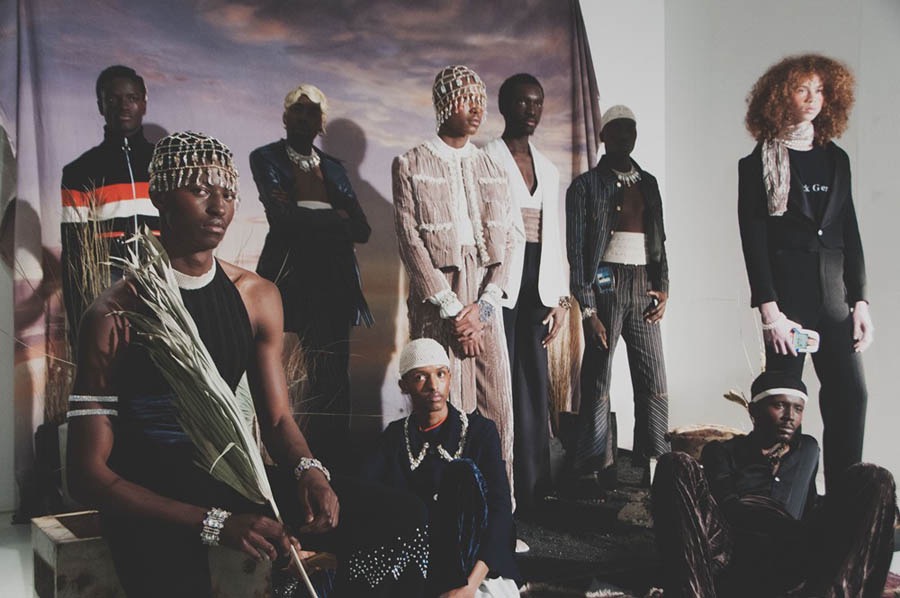
Via Griot Magazine, 2015
Her first runway show, titled Ebonics, was an impressive display of both personal heritage and historical knowledge, referencing a 1970s era Lagos, Nigeria. Ebonics imagines Black male identity through a symphony of perspectives, showcasing clothing that could be worn by one’s father or by a younger man, exploring tones of homosexuality alongside the historical portrayal of Black men in art. This exploration aims to dismantle antiquated
Ideas of how Blackness should be depicted, generating visual scenes of Black men dressed as the subjects of Renaissance paintings. The models in the show wore suits that mimicked the hallmarks of 1970s-era design principles, intertwining texture and color to create an intriguing and distinctive visual dynamic. Many looks in the collection also included headdresses that were made out of stones and linked together, denoting some models as royalty within this Renaissance context. For many today and in the 19th century, the visuals this show presents could induce intense confusion, as seeing Black men portrayed as dignified, authentic, and important people is a concept that the Western world has consistently struggled with and subsequently denies the existence of.
Wales Bonner’s debut collection represents how her style is both refined in presentation and radical in messaging. While historically informed, none of Wales Bonner’s work in the past decade has intended to be nostalgic; instead, it utilizes the idea that in order to look forward, one must look back to find connections across time.
Grace Wales Bonner is a name that has undoubtedly come up when several fashion houses have discussed Creative Director roles, though the designer herself has said that she would only join a heritage tailoring brand that would allow her to disrupt the implicit classicism embedded in luxury fashion, specifically naming Hermès. Hermès has been able to move more slowly as a house compared to its French counterparts because of its emphasis on craft rather than output, aligning with the methodology Wales Bonner has always worked with.
Grace Wales Bonner has always resisted feeling locked in when designing, always showcasing how fashion is so much more than simply items one puts on, by instead reimagining fashion as communicating a part of a larger cultural narrative.
 cufashionsociety.com
Leave a comment