By: Fiona Poth
The exhibit Man Ray: When Objects Dream is now open at the Metropolitan Museum of Art through February 1, 2026. This immersive exhibit, curated by Stepanie D’Alessandro and Stephen C. Pinson and the first to focus on Man Ray’s rayographs, contains more than one hundred and fifty of his works, including rayographs, paintings, drawings, prints, photographs, films, and sculptures borrowed from more than fifty museums and private collections. The exhibit is impressive because of its breadth and depth and well worth visiting. However, the exhibit does not include any of Man Ray’s fashion photography taken over nearly twenty years and overlooks how this work led to his creation of the rayograph, which would define his artistic career.
Man Ray (1890–1976) was an innovative American visual artist who liked creating with light and contributed significantly to the Dada and Surrealist movements. The Dada movement began in response to the violence of World War I, as artists questioned traditional societal values and artistic methods. Dada artists reframed everyday objects as art and favored collage and chance to create. The Surrealist movement followed the Dada movement. Influenced by Sigmund Freud, surrealists believed that art should be driven by the subconscious mind and the dream state. These movements influenced Man Ray’s creative thinking. He embraced chance in his art and discovered light as a medium.
Born Emmanuel Radnitzky in 1890 in Philadelphia, Man Ray was raised in Brooklyn. As a young adult, he studied painting in New York City. During this time, he was introduced to French artist Marcel Duchamp (1887–1968), an important figure in the Cubism, Dada, and Surrealist movements, who inspired him to move to France. Man Ray arrived in Paris in 1921. Shortly after arriving in Paris, his first solo art show failed, and he needed a means to support himself. Through a mutual friend, he was introduced to French fashion designer Paul Poiret. Poiret was fascinated with Man Ray’s style and wanted to produce innovative fashion photography.
It was while shooting fashion photographs for Poiret and developing them in his Paris darkroom that Ray accidentally rediscovered the photogram. He started creating photograms intentionally in 1922, placing common objects including kitchen tools, buttons, springs on light sensitive paper, and exposing them to light to create images. He called these cameraless images “rayographs.” This process captures the outlines of the objects and their negative spaces but distorts them, creating mysterious, dreamlike images that seem both familiar and foreign at the same time. Objects lose their recognizable characteristics and three-dimensionality. Each rayograph invites the viewer to enter her subconscious and imagine what the image is. Ray’s rayographs became symbolic of the Surrealist movement and appeared in numerous surrealist journals. The MET exhibit features more than sixty rayographs.
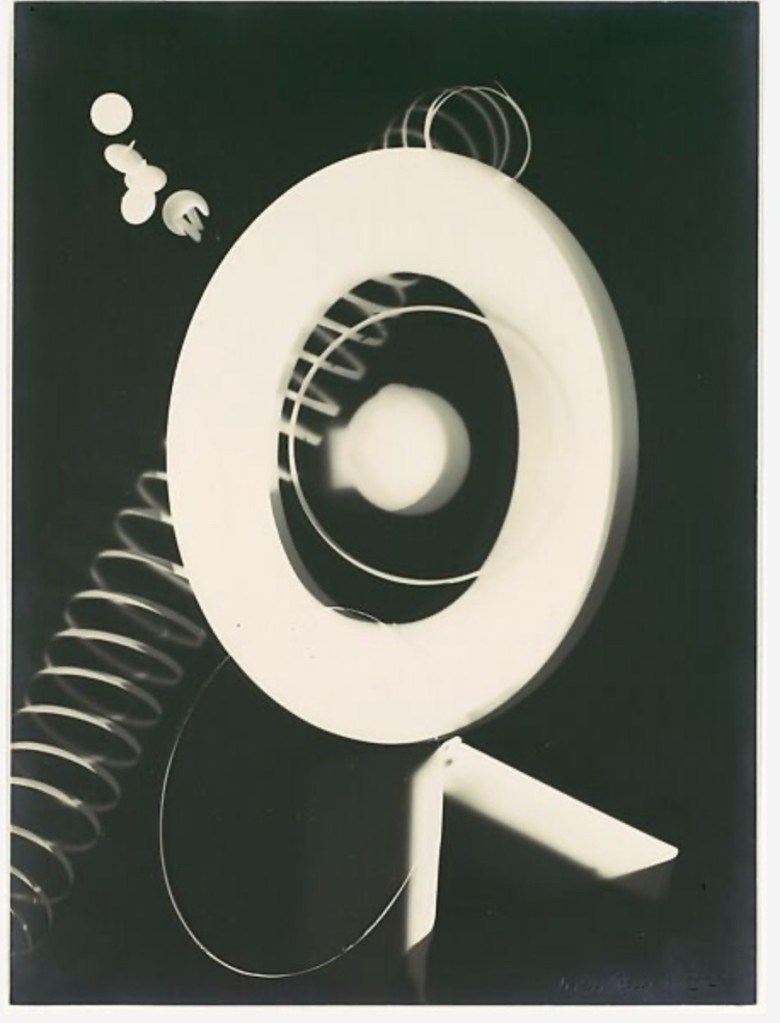
Rayograph (1922), The MET
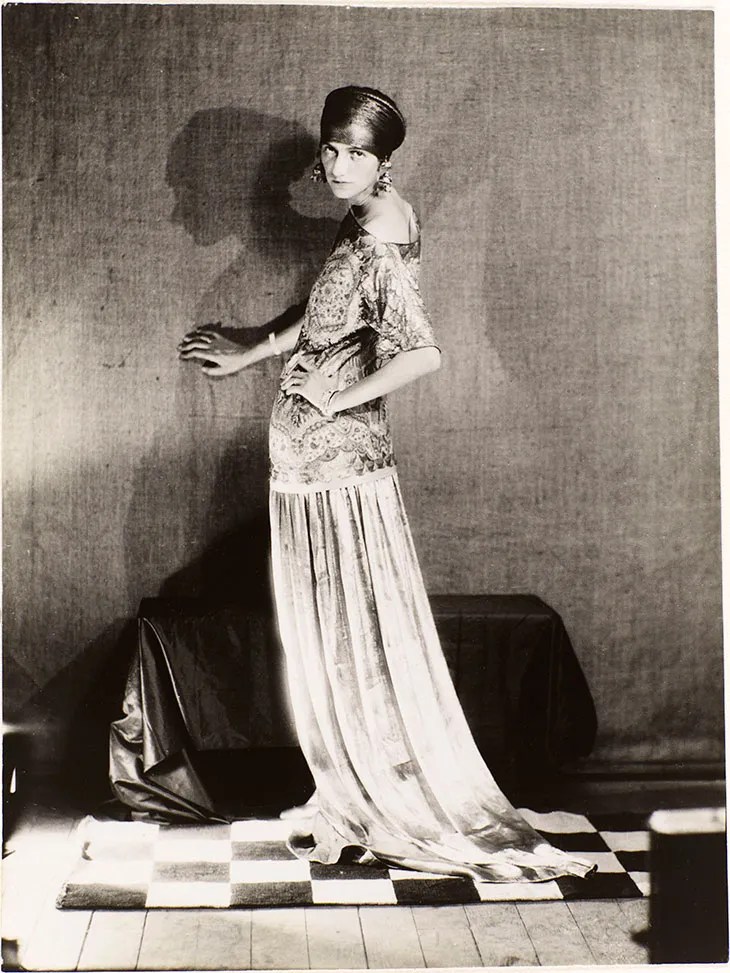
This technique caught the attention of the editors at Vanity Fair, who featured several of Man Ray’s rayographs in the November 1922 issue. After the success of his article in Vanity Fair, Man Ray became a popular photographer for other large fashion publications such as Vogue and Harper’s Bazaar. He also regularly photographed upper-class society figures like Peggy Guggenheim wearing high-fashion pieces, and these photographs were featured in fashion magazines such as Vogue. In this particular portrait, Ms. Guggenheim, who is wearing an exotic design with opulent details by Paul Poiret, has assumed an unexpected pose and shadows mirror her form.
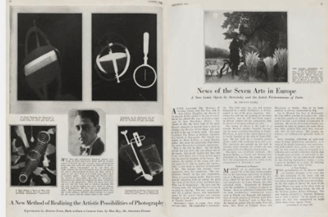
Vanity Fair, November 1922
Man Ray’s fashion photographs were a sharp departure from the traditional drawn fashion illustrations and formal studio portraits of the time. For example, in Man Ray’s photograph Observatory Time–The Lovers (1936), a model wearing an Elsa Schiaparelli gown is reclining on a sofa with her arm raised in a sculptural pose in front of Man Ray’s large-scale painting Observatory Time–The Lovers (1936). Man Ray used light to create unique shadows and drama in his fashion photographs. He did not simply photograph clothes; he told a story with his fashion photos. Man Ray’s approach and technique transformed and modernized fashion photography.
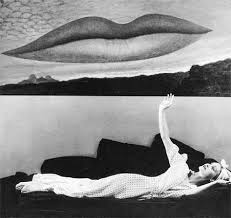
Observatory Time – The Lovers (1936)
Soon, Man Ray was also sought as an advertising photographer. One of his most famous ads was for a Cosmècil Mascara ad in 1935. He used a cropped version of his work, Untitled (Glass Tears) (ca. 1930–1933). The ad focused on one eye of the model, with glass tears dotted across her cheeks to promote waterproof mascara. In this way, Man Ray elevated commercial advertising to art. This photograph can be viewed at The MET.
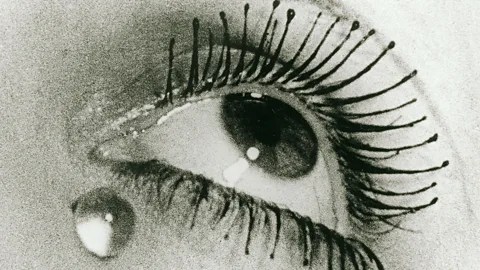
Cosmècil Mascara ad (1935)
Concerned that his commercial reputation was beginning to overtake his artistic one, Man Ray abruptly quit taking fashion photographs and working in advertising in 1939.
During the nearly twenty years he worked as a fashion photographer, Man Ray transformed fashion photography, incorporating Dada and Surrealist elements. He merged these artistic movements with fashion, showing that garments can evoke a dreamlike state, push back against society’s rationalism, and embody creative innovation.
 cufashionsociety.com
Leave a comment