By: Sunanya Guthikonda
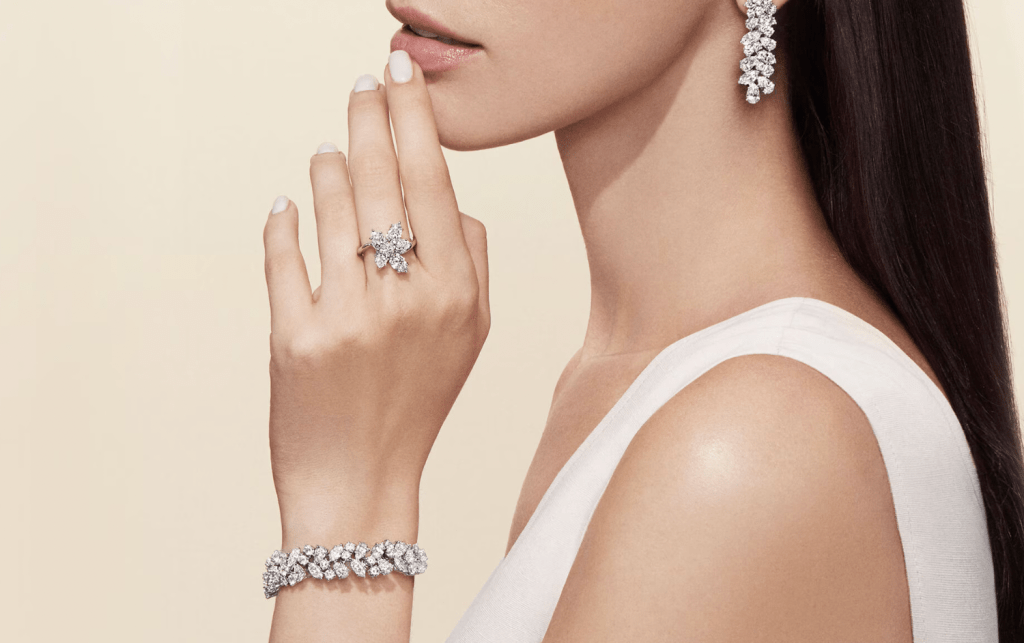
The Winston Cluster serves as a vignette of fashion’s entanglement with economics, crystallizing the relationship between production, marketing, and consumption of luxury goods, particularly with symbolic significance. The Winston Cluster functions as a microcosm of the modern luxury economy that is able to embody the social ideals of wealth and aspiration through curated aesthetics. Like many luxury goods, the Winston Cluster exists not only as a purchasable good but as an object of cultural capital, whose symbolism determines price more than cost of production.
Known to many as “The King of Diamonds,” Harry Winston launched his eponymous brand in 1932, with his original pieces and designs aiming to exemplify luxury and innovation. The iconic Winston Cluster arose after Winston, observing the holly wreath on his home in Scarsdale on a winter evening in the 1940s, noticed how the leaves caught the light and appeared to float against the dark branches (Parker). This image inspired the Cluster’s design, built around the idea that diamonds, like nature, should dictate their own form. Over seventy-five years later, this sculptural arrangement remains the emblem of Harry Winston.
From an economic standpoint, the Winston Cluster functions as a textbook commodity with both use value and exchange value. The use value lies in expert craftsmanship, curated aesthetic appearance, and symbolic prestige. Each piece is handcrafted with 6 pear-shaped and 4 marquise diamonds totaling about 4.62 carats, all set in platinum. The design features diamonds set at various angles with minimized platinum visibility, maximizing light reflection and brilliance. They are designed for evening wear, gala events, and red carpets, symbolizing exclusivity, status, and taste. The exchange value derives from labor, materials, and the global diamond industry, which sets prices based on carat weight, cut, clarity, and color, creating a standardized monetary exchange. The exchange value is quantifiable through market price, deriving from brand prestige, the properties of the diamonds (D–F color, VVS clarity grades), and historical craftsmanship that ensures potential for high resale.
The Winston Cluster design, though marketed as unique, is reproduced in varying sizes and price tiers, enabling broader market reach while maintaining exclusivity. This controlled reproducibility situates these pieces as simultaneously rare and tradable. This paradox marks its commodification.
The Winston Cluster is an ideal example of conspicuous consumption, as a highly socially recognized commodity with an established legacy. Harry Winston describes it as “a symbol of American glamour,” a “celebrated design,” and a “red carpet icon.” As a signature of the brand, it has become one of the most sought-after designs, especially among high-profile clients, including Jennifer Lopez, Kerry Washington, Natalie Portman, and Charlize Theron. Given their association with celebrities, they have become a symbol of social status autonomously imparted onto the wearer; purchasing and wearing them is motivated by the desire to broadcast affluence, not by functional necessity.
This mechanism transforms the Winston Cluster into a Veblen good, a product for which demand rises with price. As prices increase, so does desirability, because a high price becomes a signifier of exclusivity. Buyers embrace inflation as evidence of prestige. The Cluster’s appearances in auction markets, selling well above market price, illustrate this phenomenon. Elevated prices intensify symbolic capital rather than repel clients. The Winston Cluster functions simultaneously as a luxury commodity, an investment asset, and a public signal of private distinction.
The economic value can be interpreted through neoclassical economics. From this standpoint, developed by Carl Menger, William Jevons, and Léon Walras, a good’s value originates in individual consumer preferences and utility derived from ownership. This valuation is subjective, determined by marginal willingness to pay rather than production cost. Pieces with the Cluster design command high prices because affluent consumers perceive their beauty, prestige, and craftsmanship as bringing exceptional satisfaction. The scarcity of high-quality diamonds, brand exclusivity, and its characteristic of being “wearable art” further enhance perceived value by amplifying demand relative to supply. The monetary value is constituted by willingness to pay, affected by income, tastes, and social signaling. Although production costs play a factor, the essence of value resides in consumers’ subjective valuation.
The enduring appeal of the Winston Cluster lies in its economic and cultural layering. It is a case study in how modern luxury markets convert scarcity into value, and how a shifting network of labor, branding, marketing, and cultural memory can be condensed into a form that appears natural and timeless. Particularly in an age when the boundaries between fashion and finance are fluid, the Winston Cluster epitomizes how reified beauty can function as capital, not only speaking to the origins of modern jewelry design, but to the economics of visibility that animate the broader luxury industry.
 cufashionsociety.com
Leave a comment