By Michael Shavelle
On a rainy day earlier this semester, I was wandering on the fourth floor of MOMA when a photography series caught my eye. A beautifully retro man stands with cocked hips and his hands tucked into a cool leather jacket. Small text protrudes from different points of his outfit, drawing the viewer in. The title spreads across his Levis: “Signifiers For A Male Response.” These signifiers are all pointed out in white ink on top of the photograph; keys, earrings, and handkerchief. The adjacent photographs zoom in on each of these aspects, explaining how the specific way the wearer would adorn these accessories would not just signify his queer sexuality, but also his leanings for sexual practices. For instance, an earring on the right lobe “may suggest that the wearer prefers to play the passive role during sexual activity.”
This series by photographer Hal Fisher of what he would call “Gay Semiotics” intrigued me deeply. As a gay college student living in New York, the role of accessories in fashion as a signifier and representation of queer identity is fascinating. But, the 1977 photography series portrays gayness in outward presentation in a much more different way than our present day. Seeing this vintage take on style as a means of signifying led me to question: is there still such a thing as “dressing gay?”
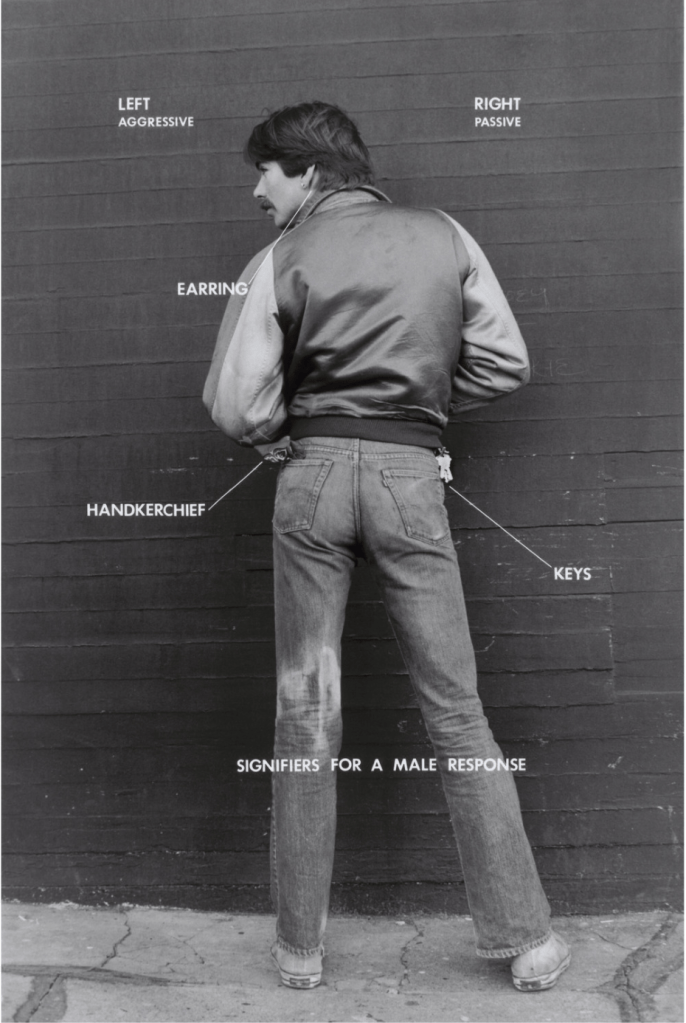
There is a long history of the use of fashion as queer signifier, from Oscar Wilde’s accessorization of a green carnation to pinky rings by lesbians in the early 20th century. These nods were subtle and, like the use of piercings, keys, and handkerchiefs in Fisher’s series, they enabled queer people to recognize one another in a time where secrecy of one’s identity was crucial for survival. The use of fashion in this way became a part of the identity. There also grew the association of traditional masculine or feminine garments worn by the opposite intended gender, which remains today as a note to express queerness. The use of garments and accessories in the 70s to discreetly hint and express one’s queer identity was popular and undeniable. As Fisher said when speaking on his larger photography collection of these gay men, “I didn’t dress those people; I found them like that.”
Can we as easily generalize a gay form of codified expression today? Hal Fisher does not seem to think so. “I don’t think this generation (of gay populations in urban centres) has a semiotics. On one level, they don’t need it. On the other level, everything is very porous. The transmission of style happens so quickly now that even if you could say, ‘This is gay,’ in a week it will be something else because it was absorbed.” Fisher speaks on the relative ease at which gay cultural items have grown to become adopted into the mainstream. Everyone and their dad has earrings in either lobes these days. TikTok boys have pioneered the carabiner to accessorize a set of keys with some Carhart work pants. And, when was the last time you saw someone with a handkerchief out of their back pocket? This assimilation is seen in other pop culture elements as well: Lady Gaga’s music that speaks so clearly on queer themes plays on every radio station and Jonathan Bailey is adored by fans of all identities.
As rights have been extended to queer people in this country, the acceptance of queerness in culture has subsequently grown. Of course, it is incredibly important and remarkable that the vastly unsafe conditions that necessitated queer subtlety in fashion choices are relatively repaired–of course, they still exist in many places and in different ways, but generally America has grown towards acceptance (which hopefully won’t be too infringed on in another four years of Trump).
I think there is nuance to this claim. Queer marginalization and otherness still exists, though, arguably, less prominently than the time of Fisher’s series. I would argue that there is still a way to dress “gay” both in the stereotypical, heteronormative view and also, subtly, within the gay community. The stereotype still seems to be that gay men tend to dress and be more feminine. While the mainstream assimilation and acceptance of gay culture has helped mend the assumption in heteronormative society that this is generally a bad thing, it is still very much there. The stereotype also seems to have evolved that gay men tend to dress better than straight men, paying more attention to the details of their outfits and looking “good.” There is something about this that feels uniquely American–the differentiation between a gay and a European seems difficult to distinguish.
This can be reductive–of course not all gay people dress in the same feminine way. While I think this can be true, I believe that the distinction isn’t in an outfit’s femininity, but rather in its authenticity. There seems to be an association between expressing your true self through clothing, especially in a way that goes against dominant, heteronormative values, that feels gay. While we have evolved past the need for semiotics, the drive for self expression and identity expression has not ceased.
Sporting some stereotypical feminine elements is the way I feel I can signal a part of myself and indulge in an authentic way of expression. Like Fisher’s semiotics, it is a way I can feel I am nodding to other gay people and feel solidarity, even if it’s arguably less than the 70s era of truer marginalization. The difference between Fisher’s time and now is that gay people can dress more outwardly authentically, not just signaling to each other but to broader society as a whole. And, most importantly, it makes me feel like my most authentic self.
The acceptance of queer culture has contributed to a sense that anyone can wear whatever they want without judgement, which is, of course, incredibly valuable. Especially living in New York, we are surrounded everyday by inspiring fashion icons, who don’t care about the gender or sexuality implications in the garments they put on their torso or the studs they place in their ears. But, when I carefully pair cheetah print jeans with Rhode blush and a cropped tank top, I can’t help but think I look at least a little gay. And, I like that.
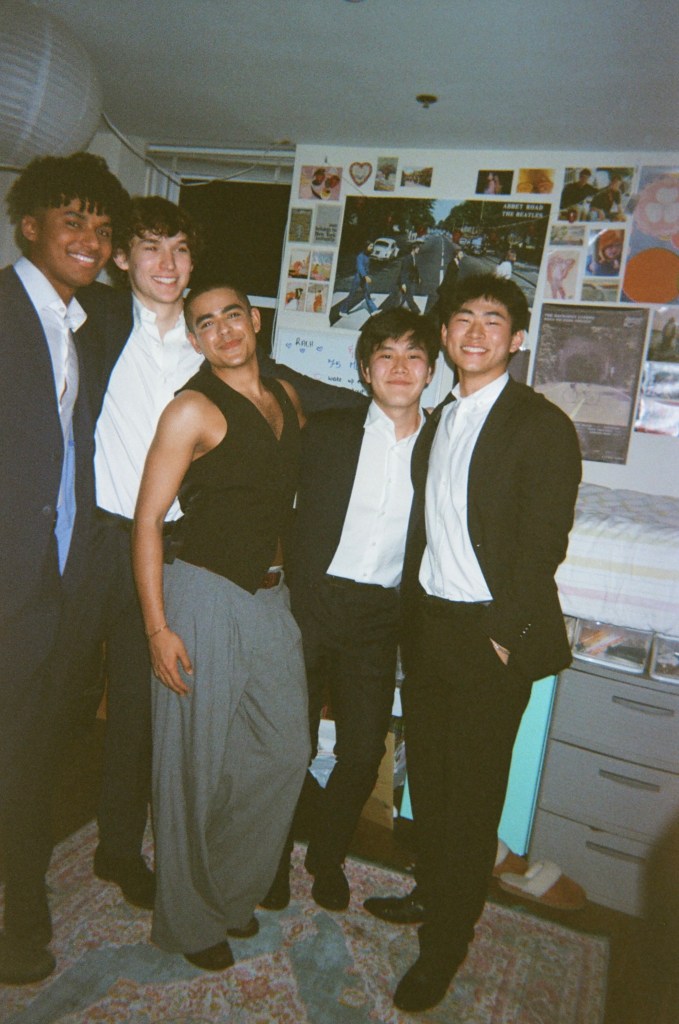
above: a picture of me “dressing gay” for a sorority formal
 cufashionsociety.com
Leave a comment